Alberta Clean Technology

From emissions to multi-stream value fractionation.

Alberta's algal photobioreactor runs on industrial CO₂ and integrates solar and wind to curb grid loads. Low-energy harvest and cascade fractionation yield lipid biofuels, pharma bio-actives, and nutraceuticals — valorising emissions into premium, diversified revenue streams.

Vivid green microalgae culture seen up close
Active photosynthetic bio-sequestrationMicroalgae intensification at work inside our photobioreactor
~1.8 t CO₂
fixed per tonne of dry biomass
5high-value product streams
24/7closed-loop process control
Our Technology

Photoautotrophic carbon bioprocessing.

Our photobioreactor enables high-density photosynthetic carbon assimilation, converting industrial emissions into a premium biomass feedstock — precisely fractionated for biofuels, nutraceuticals, and pharmaceutical actives.

Integrated platform capabilities
Industrial flue-gas CO₂ sparging & dissolution
High-density phototrophic cultivation
Irradiance, macronutrient dosing, thermoregulation & pH control
Real-time process monitoring (PAT): cell density, dissolved O₂/CO₂
Automated biomass recovery, dewatering & processing
Modular reactor architecture: pilot → demo → commercial
Solar & wind integration to curb grid loads
Cascade fractionation into targeted product streams
With a carbon-fixation efficiency of ~1.8 t CO₂ per t dry biomass, our PBR achieves engineered photosynthetic bioconversion — routing inorganic carbon into targeted lipid and nutraceutical precursor pools under closed-loop control.
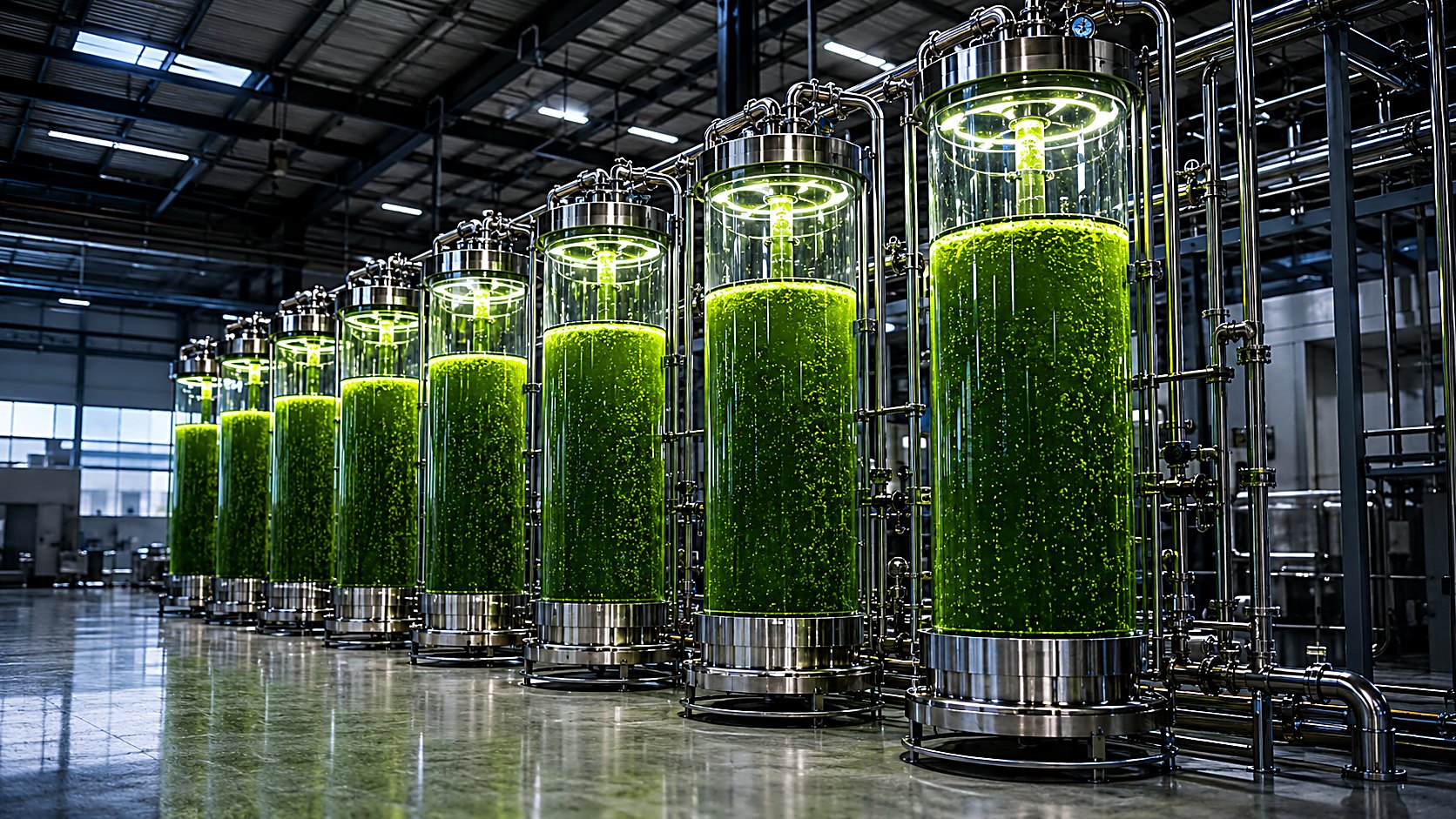
Rows of vertical photobioreactor columns filled with green algae culture in a production facility
Modular photobioreactorsEngineered for performance. Designed for scale.

How it works

01
CO₂ Sourcing

CO₂-laden flue gas is collected from an industrial source, conditioned, and fed into the cultivation system.

02
Algal Cultivation

Selected algae strains take up that CO₂ using light, water, and nutrients to build biomass inside the photobioreactor.

03
Automated Process Control

Sensors track the culture continuously while controls adjust CO₂ injection, light, and nutrient dosing to maximise carbon fixation.

04
Biomass Collection

At peak density the biomass is separated and concentrated by flotation, then routed downstream for extraction.

05
Biomass Valorization

Cascading fractionation generates high-value streams: nutraceuticals, pharmaceuticals, aquafeed, biodiesel, and residual fractions for effluent treatment.

Solutions for Industry

From first assessment to commercial scale.

Practical algae-based solutions that fit your site, your emissions, and your goals.

Integrated Scale-Up & Site-Specific Engineering

The cultivation platform is engineered to the unique emission characteristics, spatial layout, and utilization objectives of each facility, supported by feasibility modelling and scale-up protocols from inception to operational handover.

Learn more →
Carbon Mitigation by Algae

Algal cultivation converts captured CO₂ into renewable biomass through photosynthetic fixation — turning regulatory compliance into a commercial opportunity.

Learn more →
Scalable Modular Cultivation Platform

The photobioreactor maintains consistent hydrodynamics, gas-liquid mass transfer, and light distribution across all capacity tiers, from bench-scale research to full commercial production.

Learn more →
Algae Biomass Product Stream

A primary deliverable is a biomass stream designed to integrate into existing agricultural additive supply chains, material compounding lines, and bioenergy conversion pathways.

Learn more →
Pilot-Scale Evaluation & Feasibility

The pilot framework characterises emission quality, site layout, strain selection and cultivation parameters, validating process performance and determining technical, economic, and commercial viability.

Learn more →
Operational Intelligence & Closed-Loop Optimization

Continuous monitoring of biological, environmental, and operational parameters optimises productivity, maximises CO₂ capture efficiency, and supports predictive maintenance for long-term performance.

Learn more →

Biomass valorization & market opportunities

Microalgal biomass offers diverse commercial opportunities as a renewable raw material for high-value products, while supporting sustainable industrial development.

Regenerative Agriculture

Biofertilizers
Soil health & microbial enrichment
Bio-stimulants
Livestock & aquaculture feed

Ecosystem Restoration

Carbon utilization
Nutrient recovery from wastewater
Water purification
Heavy-metal adsorption

Algal Bio-Composites

Biopolymers & bioplastics
Renewable packaging
Bio-based chemicals
Circular industrial products

Renewable Bioenergy

Biodiesel & bioethanol
Sustainable aviation fuel
Renewable natural gas
Waste-to-energy integration

Algal Bioactive Compounds

Nutraceuticals & functional foods
Pharmaceutical actives
Pigments & antioxidants
Proteins, lipids & omegas

Commercial applications depend on algae strain, cultivation conditions, processing requirements, regulatory approvals, and market demand.

Why BioTek Canada

Built for Alberta industry.

Alberta has the industrial expertise, research capacity, agricultural resources, and energy infrastructure required to lead the next generation of carbon-utilization technology. BioTek Canada — a startup based in Edmonton — is kickstarting that transition, connecting those strengths with the emerging bioeconomy.

Energy & Petrochemicals Cement & Manufacturing Agriculture & Food Production Municipal & Industrial Wastewater Greenhouses & Controlled Agriculture Research & Technology
01
Carbon becomes an input

We approach CO₂ as a usable resource rather than only a waste stream.

02
Modular and scalable

Begin with a pilot installation and expand as performance, demand, and opportunities are validated.

03
Multiple value pathways

Algae biomass supports several downstream markets — opportunity beyond carbon reduction alone.

04
Data-driven operations

Monitoring and control systems provide visibility into cultivation conditions and performance.

05
Designed for collaboration

We work with industrial operators, researchers, governments, investors, and technology partners.

The transition to a lower-carbon future requires solutions that are practical, scalable, and economically meaningful — connecting industrial emissions with renewable biological production.

Less waste. More value. A new future for industrial carbon.

Let's turn emissions into opportunity.

Exploring carbon reduction, algae production, biomass applications, or industrial sustainability? Connect with BioTek Canada to discuss a pilot project, research partnership, technology collaboration, or investment opportunity.

We typically respond within one business day.